What College Tennis Coaches Actually Look For in a Recruitment Profile
What actually gets a junior player recruited: UTR trends, a highlight video coaches will watch, tournament history, academic eligibility, and a profile that's easy to evaluate. A realistic timeline included.
What College Tennis Coaches Actually Look For in a Recruitment Profile
Every year, thousands of junior players and their parents chase the same goal: a spot on an NCAA tennis roster, ideally with a scholarship attached. And every year, most of them make the same mistake — they focus almost entirely on winning more matches, while the actual recruiting process runs on something slightly different: a profile a coach can evaluate in minutes, not a reputation built over years.
College coaches don't have time to watch every promising junior play in person. With limited recruiting budgets and hundreds of prospects to sort through, they rely on a handful of specific things to decide who's worth a closer look. Understanding exactly what those things are — and building a profile around them early — changes the entire trajectory of the recruiting process.
1. Your UTR (Universal Tennis Rating), Not Just Your Win Record
If there's one number that dominates college tennis recruiting in the U.S. today, it's UTR. The Universal Tennis Rating puts every player in the world — regardless of age, gender, or country — on the same 1.00 to 16.50 scale, based on actual match results rather than age-group rankings. This is exactly why it has become the reference point the large majority of college coaches check first: a coach in Texas can directly compare a recruit from Bucharest with one from Boston, without needing to know anything about either country's domestic ranking system.
What trips up a lot of families is assuming that win-loss record and UTR tell the same story. They don't. UTR weighs the strength of the opponent — a close loss to a much higher-rated player can raise a rating more than a lopsided win against someone far weaker. Coaches specifically look for players who compete against strong fields and hold their own, not players who accumulate wins against overmatched opponents. A rising UTR trend across multiple seasons, built against progressively tougher competition, is exactly the story coaches want to see.
2. A Highlight Video That Respects Their Time
Recruiting videos are often the first real impression a coach gets of a player — frequently before ever seeing them play live. Coaches reviewing dozens of prospects a week simply won't sit through a 20-minute unedited match. The videos that actually get watched to the end share a few things in common:
- Match footage over drilling — coaches want to see how a player constructs a point, reacts to losing one, and handles pressure, not just clean strokes in isolation
- The strongest points up front — the first 30 seconds need to earn the rest of the coach's attention
- A reasonable length — typically 3 to 5 minutes of genuinely representative play, not a highlight reel padded with repetitive winners
- Footage from different surfaces and opponents — this shows adaptability, which matters more at the college level than dominance on a single surface
- Basic identifying info up front — name, graduating class, and UTR, so the coach has context before the footage even starts
None of this requires a professional production crew. Clear, well-framed footage from a phone is enough — what matters is what's actually happening in the footage, not how polished the editing looks.
3. Tournament History That Shows a Trend, Not Just a Result
Coaches don't just glance at a win-loss record — they study the tournament history behind it to understand level, consistency, and competitive mindset. Three things stand out in that history more than any single result:
Progression over time. Are results improving? Is a player learning from early exits and coming back stronger the following season?
Match toughness. A close, competitive loss against a significantly higher-ranked opponent often reads better to a coach than an easy win — it shows a player who can compete, not just accumulate favorable matchups.
Willingness to be tested. Players who consistently enter tougher events — ITF junior tournaments, higher-level national and regional competitions — signal ambition, even when it comes with tougher losses along the way. Coaches read that as resilience, not risk.
This is exactly why a simple running record of tournament results, kept consistently rather than reconstructed later from memory, becomes so valuable. It's the difference between telling a coach "I've been improving" and being able to show precisely how, tournament by tournament.
4. Academic Eligibility — Handled Early, Not as an Afterthought
A player can be talented enough to make any roster in the country and still lose recruiting interest over academic eligibility issues discovered too late in the process. For international student-athletes especially, this part of the process has real lead time attached to it.
The NCAA Eligibility Center reviews academic records and amateurism status before certifying any international student-athlete to compete at the Division I or II level. Because education systems vary significantly by country, international families are specifically advised to register with the Eligibility Center before the equivalent of ninth grade, and to submit academic records — often with certified line-by-line English translations — well ahead of the recruiting timeline, not during it.
Coaches are aware of how often this step gets delayed by families focused entirely on the athletic side. A player who has already handled eligibility paperwork removes a real point of friction from a coach's decision — one less unknown standing between interest and an actual offer.
5. A Profile That's Easy to Find and Easy to Trust
None of the above matters if a coach can't find it, or can't quickly verify it's accurate. This is where a lot of otherwise strong recruits lose ground — their best results are scattered across old emails, a parent's memory, or a video sitting unlisted on a phone, rather than organized somewhere a coach can review in one sitting.
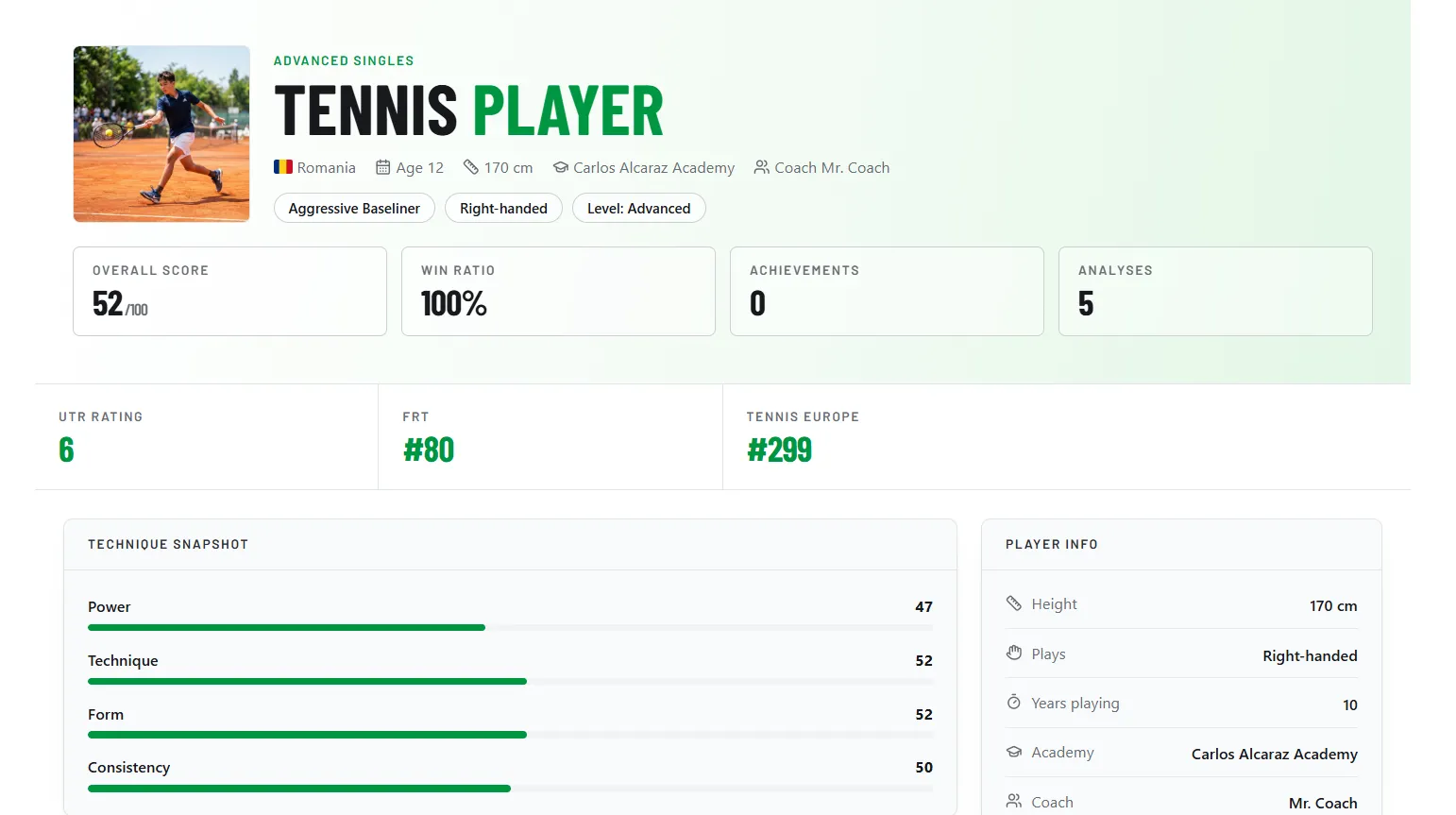
A recruitment profile that presents verified match history, rating trends, and video in a single, credible format does two things at once: it saves the coach time, and it signals that the player takes the process seriously. Coaches with limited hours to allocate across hundreds of prospects consistently favor the recruits who make evaluation easy over those who make a coach dig for basic information.
Build a recruitment profile coaches can actually evaluate in one look.
Verified match history, rating trends, and highlight video in one shareable link — built to the format college coaches actually read.
Build My Profile Free6. Communication That Shows Genuine Interest
Talent gets a player noticed. How a player and family communicate during the process often decides what happens next. Coaches have limited recruiting time and budget, and they notice which recruits respond to inquiries, follow up appropriately, and are upfront about their level of interest in a program — even when that means saying no to a school that isn't the right fit.
This matters more than it might seem: a coach investing time in a recruit who then goes silent, or who was never seriously interested, is time that coach can't spend on someone who was. Being direct and responsive, even with disappointing news, tends to keep doors open elsewhere far better than going quiet ever does.
Putting It Together: A Realistic Recruiting Timeline
Families often start this process later than they should, simply because no single moment announces "recruiting starts now." In practice, the pieces described above — UTR history, tournament results, video, academics — are best built gradually, starting well before the recruiting conversations actually begin:
- Ages 12–14: Start tracking match results and UTR consistently. Register academic records early if pursuing NCAA Division I or II as an international student.
- Ages 14–16: Begin building a highlight video from strong match footage. Enter tougher tournaments deliberately to build a meaningful UTR trend, not just a favorable record.
- Ages 15–17: Assemble everything — UTR trend, tournament history, video, academic standing — into one shareable profile. Begin direct, honest communication with coaches at target programs.
- Ages 17–18: Finalize NCAA eligibility certification and keep the profile updated with the most recent results as decisions approach.
The families who navigate this most smoothly aren't necessarily the most talented — they're the ones who treated the profile as something built over years, not assembled in a rush during junior year of high school.
Where to Learn More
- NCAA International Student Initial Eligibility Requirements — official academic and amateurism requirements for international recruits
- USTA College Tennis Recruiting Education — direct guidance from college coaches on the recruiting process
- ITF Player Pathway — how junior competitive results build toward higher-level opportunities
- Not sure which training environment supports this path best? See our guide to The Complete 10-Year Pathway for Junior Tennis Players