How to Track Your Junior Tennis Player's Progress (Free Tools & Methods)
A practical guide for tennis parents: what to track (match stats, UTR, video technique), free manual methods vs. automated tools, and how to turn tracked progress into a college recruitment profile.
How to Track Your Junior Tennis Player's Progress (Free Tools & Methods)
If your child plays competitive tennis, you already know the feeling: after every tournament, every practice, every lesson, you're left wondering — is this actually working? Are they getting better? Is the money and time going somewhere real?
Most parents track progress the way most parents track everything else in their kids' lives — informally. A win here, a loss there, a coach's comment after practice. It's not enough, and it's not your fault. Until recently, there wasn't an easy, structured way to do better, unless you happened to be at an academy with its own analytics team.
This guide walks through exactly how serious tennis families track development today — what to measure, how the systems coaches actually use (like UTR) work, free manual methods, and automated tools that do most of the work for you.
Why "Just Watching Them Play" Isn't Enough
Progress in tennis isn't linear, and it isn't always visible from the sidelines. A player can lose more matches in a given month while their underlying game — serve consistency, shot selection, movement — is objectively improving. Conversely, a string of wins against weaker opposition can mask stalled technical development, or worse, reinforce bad habits that will get punished at a higher level.
This is exactly why federations like the International Tennis Federation structure junior development around measurable pathways rather than just win-loss records — rankings, ratings, and specific competitive milestones that give a clearer picture than "did they win today."
The families who navigate junior tennis most successfully treat it less like a series of isolated events and more like a long-term dataset. Every match, every practice session, every piece of coach feedback is a data point. Individually, none of them tell you much. Together, over months and years, they tell you almost everything you need to know about whether your child is developing in the right direction.
What to Track (And Why Each One Matters)
1. Match results and win rate over time
Not just whether they won, but against whom, and how the trend looks over months, not single events. A single bad tournament means very little. A downward trend across ten tournaments means something worth addressing with the coach.
2. Serve and return stats
First serve percentage, unforced errors, break points won and lost. These numbers often reveal problems long before they show up in the scoreline. A player can win a match 6-4, 6-4 while double-faulting on nearly every important point — a coach who only sees the score misses the warning sign entirely.
3. Technique on video
A weak second serve or an inconsistent backhand rarely gets fixed by feel alone. Recording practice sessions and matches — even just on a phone propped against a fence — gives you and the coach something concrete to look at, frame by frame, instead of relying on memory of "it looked off today."
4. Physical and competitive milestones
Age-appropriate benchmarks matter here. Organizations like USTA Player Development publish guidance on tournament structures and progression that can help you understand whether your child's competitive schedule matches their stage of development, rather than pushing them into events they aren't ready for.
5. UTR (Universal Tennis Rating)
If you're serious about tracking progress and you haven't looked closely at UTR yet, this is the single most important number to understand. UTR rates every player in the world — junior, adult, collegiate, professional — on the same 1.00 to 16.50 scale, based purely on match results rather than age group or region. A 13-year-old with a UTR of 6.0 and a 17-year-old with a UTR of 6.0 are considered the same playing level.
What makes UTR different from most ranking systems is that it factors in the strength of the opponent. A close loss to a much higher-rated player can actually help a rating more than an easy win against a weaker one — which means chasing lopsided wins against overmatched opponents is often a poor strategy if the underlying goal is rating growth, not just a good-looking scoreline.
This matters enormously for the road ahead: the large majority of college tennis coaches in the U.S. reference UTR as one of the first data points when evaluating a recruit, specifically because it allows them to compare a player from Florida with a player from Romania or France on the same scale. If college tennis is even a distant possibility, UTR trend lines should be part of what you're tracking from early on, not something you start paying attention to in the final year of high school.
Method 1: Manual Tracking (Free, but Time-Consuming)
A simple spreadsheet can work if you're consistent. Here's a structure that covers the essentials:
- Match log tab — one row per match: date, opponent, score, surface, first serve %, unforced errors, and a short note on what worked or didn't
- Technique notes tab — a running log after each coaching session, so recurring feedback (e.g. "still rushing the second serve toss") becomes visible over weeks instead of getting forgotten
- Video folder — organized by date and stroke type, so you can pull up a serve from six months ago and compare it side by side with a recent one
- UTR snapshot — recording the rating once a month lets you see the actual trend line, not just the current number
This approach costs nothing and works reasonably well for families who are disciplined about updating it. The honest downside: most parents fall behind within a few weeks, especially during busy tournament stretches when there's the least time to sit down and update a spreadsheet — which is exactly when the data would be most useful.
Method 2: Automated Tracking (Free to Start)
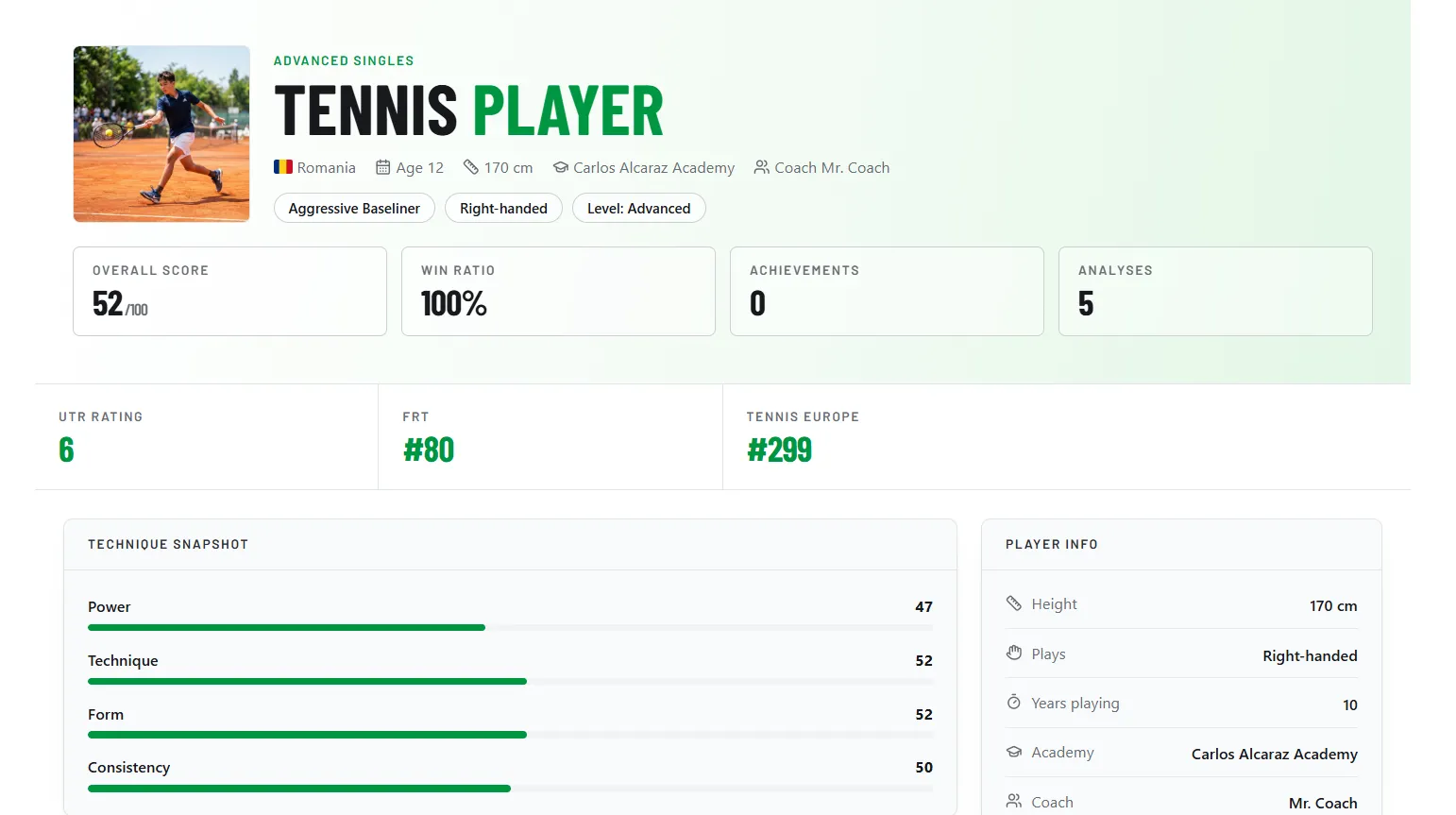
This is where a tool built specifically for this job saves hours and catches things a spreadsheet never will. TennisDex's tracking dashboard was built around exactly this problem: score matches live from your phone courtside, and the analytics — win rate trends, shot breakdowns, serve stats, surface performance — build themselves automatically, no manual data entry required after the fact.
Skip the spreadsheet — track everything automatically, free.
Score matches from your phone, get AI feedback on technique, and build a profile that's ready to share with coaches whenever you need it.
Start Tracking FreeBeyond match stats, the dashboard also handles the part most families struggle with most: technique analysis. Upload a clip of a serve, forehand, or backhand, and AI-powered feedback breaks down the mechanics and flags specific areas to work on — the kind of frame-by-frame review that used to require a specialist coach sitting down with a laptop and slow-motion footage.
Because everything is timestamped and stored automatically, comparing a player's technique or performance now versus three or six months ago takes seconds instead of digging through old phone videos trying to remember which clip was from which month.
A Simple Weekly Tracking Routine
Whichever method you use, consistency matters more than complexity. A routine that actually gets followed beats a perfect system that gets abandoned after three weeks. Here's a routine that works for most competitive junior families:
- After every match: log the score, one sentence on what went well, one sentence on what to work on
- After every coaching session: note the one technical cue the coach emphasized most
- Once a week: record 2-3 minutes of serve or groundstroke video during practice
- Once a month: review the trend — win rate, UTR movement, recurring technical notes — and discuss it with the coach directly, using the data as the starting point for the conversation rather than a general "how's it going?"
That monthly review is often the most valuable ten minutes in the entire process. It turns a vague sense of "I think they're improving" into a specific, evidence-based conversation with the coach about what's actually changing and what still needs work.
Common Mistakes Parents Make When Tracking Progress
Focusing only on tournament results. Tournaments are a small, high-pressure sample of a much larger body of work. A single bad weekend can overshadow months of genuine technical improvement if it's the only thing being measured.
Ignoring the strength of opposition. A 6-1, 6-0 win means very little if the opponent was significantly weaker. This is precisely the blind spot that rating systems like UTR are designed to correct, since they weigh results by opponent strength rather than treating every win the same.
Waiting too long to start. Some families only begin serious tracking once college recruiting becomes a real conversation — typically around age 14 or 15. By then, there's no way to reconstruct two or three years of match history, video, or rating trends. Starting the habit early, even informally, means that history already exists when it's actually needed.
Tracking everything, reviewing nothing. Data that's collected but never reviewed doesn't help anyone. The value comes from the monthly (or even quarterly) conversation where the numbers actually inform a decision — adjusting the training focus, entering different tournaments, or addressing a stalled metric directly.
Turning Tracked Data Into a Recruitment Profile
If college tennis is even a possibility down the road, tracked data becomes more than a nice-to-have. Coaches want to see match history, rating trends, and ideally video, all in one place, and they want it presented clearly rather than scattered across text messages, old emails, and a parent's memory of "he played really well against that one guy from Spain."
A dashboard that's been building this record since your child was 12 or 13 puts them years ahead of a player who only starts compiling this information as a junior in high school. It also removes a huge amount of last-minute scrambling — instead of trying to reconstruct two years of results the week before reaching out to college programs, the full history is already there, organized and ready to share.
For families exploring the path toward college tennis specifically, it's worth reading our broader breakdown of what that journey actually looks like from a young age through recruitment: The Complete 10-Year Pathway for Junior Tennis Players.
Choosing the Right Training Environment to Match the Data
Tracking progress is only half the equation — the other half is making sure the training environment actually supports the areas the data says need work. If serve stats are stagnant despite months of match play, that's often a signal to look at coaching quality or training volume, not just "play more tournaments." Comparing academies by their coaching philosophy, facilities, and specialization can help match a player's specific development needs to the right program, rather than choosing based on reputation alone.
You can start building that record today, for free, without any of the manual spreadsheet work — start tracking here.
Where to Learn More
- ITF Junior Tennis Initiative — official guidance on junior development pathways
- USTA Player Development — rules and structure for competitive junior tennis in the US
- ITF Development Strategy & Resources — official publications on coaching and player development
- Looking for the right training environment to pair with your tracking? See our guide to Best Tennis Academies in Europe for Juniors