Best Tennis Academies in Spain for Juniors (2026)
A practical long-form guide for parents comparing the best tennis academies in Spain for juniors, with advice on coaching, boarding, schooling, surfaces, costs, tournament access, and academy fit.

Spain remains one of the first countries families consider when searching for a serious junior tennis environment in Europe. That is not just because of history or reputation. It is because Spain offers something many families are actually looking for in practice: strong outdoor training culture, a deep clay-court tradition, a long competitive season, respected coaching ecosystems, and a wide range of academy models from elite global brands to smaller performance-focused centres.
But choosing among tennis academies in Spain is not simple. A famous name does not automatically mean the best fit. A beautiful facility does not guarantee the right daily structure. And an academy that works brilliantly for a highly independent 16-year-old may be the wrong environment for a 10-year-old who still needs a gentler transition, stable schooling, or a lower-pressure setup.
That is why parents need a comparison framework, not just a list of academy names. In this guide, we will look at what makes Spain such an important destination for junior tennis, what families should compare before making a decision, and which academies or academy types may be relevant depending on the player’s age, level, maturity, and goals. We will also connect this article to useful TennisDex pages such as the academy directory, age-based academy pages for 10–12 year olds, 13–16 year olds, and 16–18 year olds, as well as trusted non-commercial sources such as the ITF and Tennis Europe.
Why Spain is such a strong country for junior tennis development
Spain’s reputation in tennis is built on more than a few famous champions. It comes from a long-standing development culture. In practical terms, that often means a training environment that values repetition, point construction, movement, resilience, and match toughness. Spain is also attractive because many regions offer strong weather conditions for outdoor training across much of the year, which can make the weekly routine more stable than in colder parts of Europe.
For some players, especially juniors who still need lots of court time, volume, and live-ball development, this matters a lot. Families often choose Spain because they want their child in an environment where tennis is deeply embedded into the weekly rhythm, not treated as a side activity.
Spain can also offer variety. Some families are looking for a globally recognised full-service academy with boarding, education integration, and international branding. Others want a more focused training base in a city or region with easier costs, less hype, or a more club-like environment. Spain can accommodate both ends of that spectrum.
Start with the player, not the brand
The most common mistake families make is starting with a famous academy name and then trying to force the child into that environment. The smarter approach is to begin with the player profile.
Ask first:
- How old is the player and what stage are they really at?
- Do they need stronger daily structure or simply a better tournament plan?
- Are they ready for boarding or would a day-based / short-block model be better?
- Do they need heavy competition, technical rebuilding, or confidence-building?
- How important is academic structure right now?
- Would the player benefit from clay-court immersion, or do they need a more mixed surface setup?
This is exactly why TennisDex’s age pages matter. A child at the early development stage often needs a very different environment from a player already preparing for a college or pro pathway. Families comparing Spain should also use the relevant TennisDex age filters for 6–9 year olds, 10–12 year olds, 13–16 year olds, and 16–18 year olds rather than assuming one academy model suits everyone.
What parents should compare when evaluating tennis academies in Spain
When families compare Spanish academies seriously, they should look well beyond reputation. The best decision usually comes from comparing six core areas: coaching structure, competition planning, boarding and welfare, education, training conditions, and total cost.
1. Coaching structure
Parents should ask who will coach the player on a normal week, not just who founded the academy. The key questions are practical: How much individual attention is there? How are groups formed? How often are players reviewed? How are technical goals tracked? Strong academies can explain how tennis, fitness, and competition planning connect rather than just listing court hours.
2. Tournament access and planning
A good Spanish location should help players access match play efficiently. But tournament density alone is not enough. Families should ask how the academy builds a schedule, whether coaches travel, how match review works, and whether the level of competition is realistic for the player’s stage. The wider junior landscape can be checked through Tennis Europe and the ITF Juniors pages.
3. Boarding, supervision, and welfare
If the player is living away from home, welfare standards are non-negotiable. Serious families should ask about supervision, routines, transport, meals, curfews, injury procedures, parent communication, and safeguarding processes. The ITF safeguarding framework is a useful external benchmark.
4. Education and school fit
One of the biggest reasons academy experiences fail is not coaching. It is education mismatch. Ask directly about school partnerships, timetable pressure, language of instruction, exam support, travel flexibility, and whether the combined load is genuinely sustainable.
5. Surfaces and training conditions
Spain is closely associated with clay, and for many juniors that is a real advantage. Clay can help players build patience, movement habits, shape, and tactical discipline. But it is still worth asking what the actual surface mix is, how many indoor options exist, and whether the player’s competition goals require more hard-court exposure.
6. Total annual cost
Headline tuition rarely tells the full story. Families should think in full-year budget terms: coaching, boarding, school, tournament travel, physio, equipment, stringing, transport, flights, and hidden extras. TennisDex’s existing article on tennis academy costs in Europe is a strong supporting read before comparing specific academies in Spain.
Different Spanish academy models families should understand
Not all academies in Spain operate in the same way. Broadly, families will run into four common models.
- Global high-performance academy: large brand, strong infrastructure, international intake, often boarding and education support.
- Performance-focused specialist academy: smaller or less globally famous, but potentially strong for specific player profiles.
- Club-plus-performance environment: good for players who need structure and quality without full academy intensity.
- Seasonal or trial-block destination: useful for families who want to test Spain before a full move, often linked to summer camps or short training blocks.
Understanding the model prevents bad comparisons. A large academy with boarding may look more impressive than a city-based training centre, but that does not mean it is better for a younger player who still needs family stability, lower pressure, or a lighter transition.
Spanish academies and internal TennisDex pages worth knowing
Families exploring Spain can use TennisDex not just as a blog resource but as a practical internal comparison tool. Depending on the player profile, some relevant academy pages on the site include
- Rafa Nadal Academy by Movistar,
- Emilio Sánchez Academy,
- JC Ferrero Equelite Sport Academy,
- Ferrer Tennis Academy La Nucía,
- Barcelona Tennis Academy (BTA),
- Valencia Tennis Academy (VTA),
- Tennis Academy Mallorca,
- Elite Tennis Academy Spain.
There are also broader club and academy entities in key Spanish tennis hubs that may matter depending on the family’s priorities, including:
- Real Club de Tenis Barcelona 1899,
- Real Club de Polo Barcelona,
- Real Club de Tenis Barcelona,
- Club de Tenis Manolo Santana,
- Club de Tenis Puente Romano,
- Club de Tenis Valencia,
- Sports Club Ferrero.
How to think about some of the best-known options
Families often begin with the most visible names, and that is understandable. A globally known academy such as Rafa Nadal Academy by Movistar may appeal to parents looking for a high-profile, fully developed international environment with major infrastructure and a clearly branded performance identity. For some players, especially those ready for a more serious all-in system, that can be attractive.
Others may look at Emilio Sánchez Academy or JC Ferrero Equelite Sport Academy because they want an academy with strong performance credentials and a long-standing place in the Spanish junior development conversation. Families drawn to the Valencia and Alicante region may also compare options such as Ferrer Tennis Academy La Nucía, Valencia Tennis Academy, and nearby club-based alternatives depending on level and budget.
Meanwhile, families who prefer Barcelona may naturally compare entities like Barcelona Tennis Academy with long-established club ecosystems such as Real Club de Tenis Barcelona 1899 or Real Club de Polo. Families leaning toward Mallorca may compare the better-known academy ecosystem with options like Tennis Academy Mallorca or other local training bases depending on the child’s stage and whether full boarding is needed.
The point is not that one of these is universally best. The point is that parents should compare academy identity, daily structure, location, and fit rather than assuming that more visibility equals better suitability.
Which parts of Spain suit different player profiles?
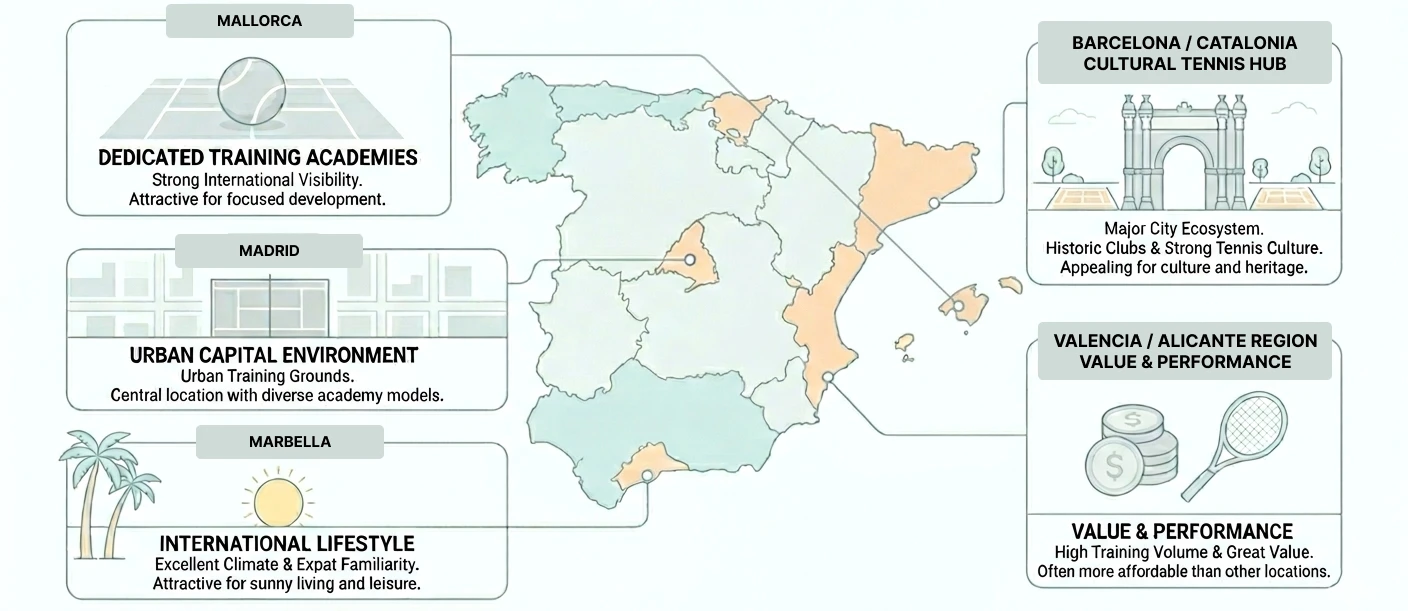
Spain is not one tennis market. Different regions can suit different families.
- Mallorca: often attractive for families specifically interested in a concentrated academy environment and strong international visibility.
- Barcelona / Catalonia: appealing for families who want a major city ecosystem, historic clubs, and strong tennis culture.
- Valencia / Alicante region: attractive for performance environments, training volume, and in some cases strong value relative to more famous locations.
- Marbella / Costa del Sol: often attractive to international families because of climate, lifestyle, and existing expat familiarity.
- Madrid: useful for families who prefer a major capital city environment, though conditions and academy models may differ from coastal training bases.
Location affects more than weather. It changes tournament travel, living costs, school options, airport access, language exposure, and the player’s day-to-day quality of life.
What type of player tends to do well in Spain?
Spain can be particularly strong for players who benefit from repetition, disciplined point construction, movement work, and long-term development structure. It may be especially attractive for juniors who need to build stronger clay-court habits, better rally tolerance, or more resilient match patterns.
That said, not every player automatically improves just because they move to Spain. A player who is emotionally unready, academically overloaded, or already physically stretched can struggle even in a respected environment. Spain is not a magic solution. It is a context, and the context only works if the player fit is right.
Questions parents should ask before choosing a Spanish academy
Before making any decision, parents should ask:
- Who will coach my child every week?
- How are groups decided and changed?
- What is the realistic tournament schedule?
- How often do coaches travel to events?
- What schooling options exist and how flexible are they?
- What is the exact boarding and supervision setup?
- What happens in case of injury or illness?
- What are the total annual costs, not just tuition?
- How often will parents receive structured updates?
- Why is this academy the right fit for my child’s current stage?
Any academy worth trusting should be able to answer these clearly and specifically.
How TennisDex should help families compare Spain intelligently
The smartest way to use TennisDex is as a layered comparison system. Start broad with the academy directory. Narrow by age and player stage through the dedicated age pages. Compare short-term versus longer-term options through summer camps. Use supporting guides such as how to choose the best academy in Europe, academy costs in Europe, and the complete 10-year pathway for junior tennis players.
If families also want a technique perspective before making a major academy decision, TennisDex’s AI Tennis Coach, Serve Analysis, and Junior Tennis Analysis tools can help provide more structured feedback on the player profile itself.
Authority sources families should trust alongside academy research
Parents should never rely only on academy marketing. Stronger decisions usually come from combining academy conversations with official and evidence-based sources. Useful external references include the ITF, Tennis Europe, the Real Federación Española de Tenis, and broader youth-sport research sources such as NCBI / PubMed when families want to think more seriously about long-term athletic development, wellbeing, and overuse risk.
Final thoughts
The best tennis academy in Spain for a junior player is not simply the one with the biggest brand, the most famous founder, or the most polished website. It is the one that best matches the player’s current stage, training needs, maturity, schooling reality, and long-term goals.
For some families, that may mean a highly visible boarding academy with deep infrastructure. For others, it may mean a more focused regional training base, a city club with strong performance culture, or even a short trial block before committing to a full move. Spain gives families many good options, but that only helps if the comparison is done well.
If you are building a shortlist now, start with the TennisDex academy directory, compare the age-specific pathways, review the relevant academy pages mentioned above, and use official sources to pressure-test what you are being told. Families who compare well usually choose better—and in junior tennis, choosing better matters more than choosing fast.